Saturday, June 10, 2017

Sad Reflection

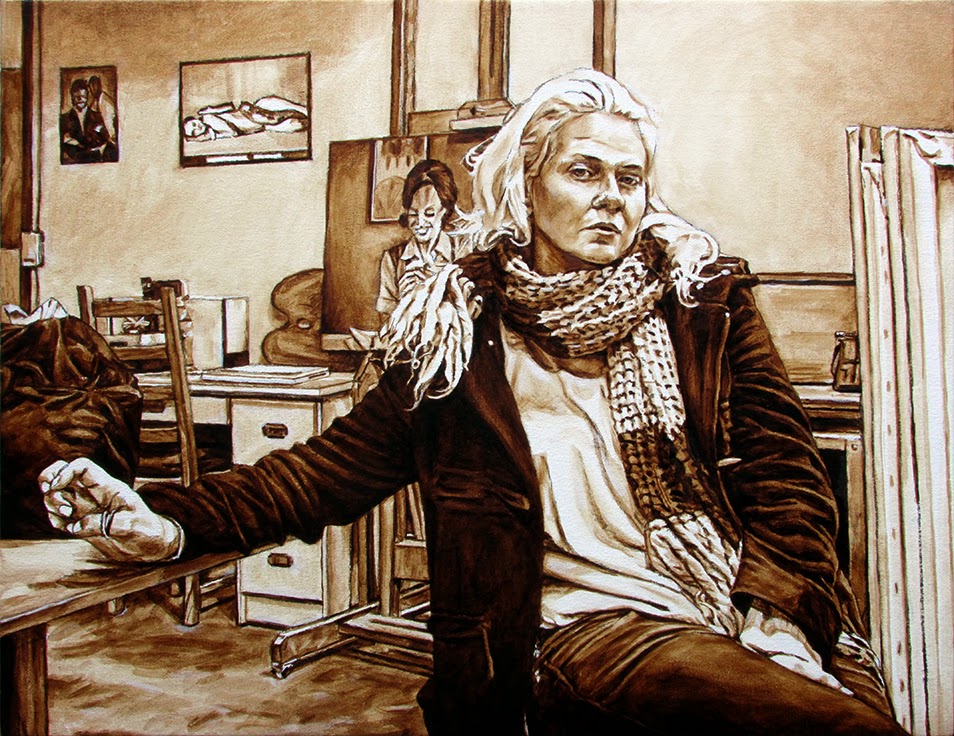
‘Moff I’ 18”x12” Oil on Canvas
Unfortunately looking back on things that I did in the past isn’t always a happy artistic experience.

An example being this painting I did of my fellow art student and former housemate Mark Moffat. I made it at the very end of 1987 (I think). I liked it then, and I still do - it has the super “high-key” chroma that I preferred back then. However, we were not encouraged to use quality materials by our teaching staff, as “It’s only student work”, and it has suffered badly over the years.

The issue here is the mix of latex emulsion paint and white PVA glue that was recommended as a primer. The ingredients were really cheap and readily available (this was before acrylic gesso was available widely), but also unstably prone to cracking. There are some really bad cracks in this painting. I imagine that glueing it down to a panel could fix most of them - but I think I will likely leave it alone as a memorial to those times.

Anyway, I erased the cracks in Photoshop as an exercise (and to spare the blushes), so the photo is back to what it was when I was in college.


Thursday, June 9, 2016

In Days of Yore

‘Happy Days’ 12”x12” Casein on Panel
A casein painting of a mounted skeleton. This reminds me strongly of my Foundation days at the long departed Banbury College of Art & Design. Years ago Banbury was the premier Foundation course in Oxfordshire - naturally it had to be closed, as all such traditional institutions are, to make way for a “University” that teaches at a far lower level. Ah well, that’s how it goes - practical monotechnic to multidisciplinary literary blancmange. 

Casein is a water-based paint that uses dairy protein as its binder; having many characteristics in common with both gouache and oils. It can be thinned to washes, or used for thick impasto. However, once it has “cured” for a few weeks it is incredibly tough and water-resistant; there are casein paintings from 9,000 years ago that have survived. Casein used to be very widely used for all sorts of painting, especially as it is so damed tough (my father once spent months blow-torching off 150 year-old casein paint from some window sashes - nothing else worked).

Every time I see a mounted skeleton I think of all the hours we used to spend observing, studying and drawing them back in Foundation college (we drew a heck of a lot of skeletons of all types). It was one of the chief tasks that we undertook, alongside life-drawing & painting, anatomy, and colour theory. We only did a small amount of Art History (perhaps 10% of our time) and no Art Criticism, as it really is’t needed to be an artist - and in many ways makes it actually much harder to be one at all.

Anyway, skeletons bring up happy memories for me. Old fashioned art education based upon observation, traditional skills and practice… and the parties were obscenely wild.

Thursday, May 19, 2016

Finished Double Portrait

‘Double Dan’ 30”x38” Oil on canvas
The finished “double portrait” of Dan that I started a while ago. This has been worked up and fleshed-out in what could be called an “indirect alla prima” technique. 

Dan is posing, showing off his images of himself, but the completed painting does actually capture a side of him, I feel - that of his “entrepreneurial” character. He's a "Dude".

Thursday, May 12, 2016

Talented Friends

10”x8” Paper negative photographic print
Not strictly totally a painting made by me this post… although there is one of mine in it.

This photographic image is one of ‘The Paper Portrait Sessions’ taken by the very talented Ross den Otter.

As part of the Vancouver Capture Photography Festival, Ross sent out an open invitation to the public to visit his studio and have a large format portrait made. He took 40 images in just over 4 hours - which is pretty quick going.

Ross built his camera obscura as a box 4 feet by 8 feet by 8 feet, made of 2×2’s, wood screws and a few layers of tar paper... so just a tad smaller than a typical Vancouver condo. He used a a WWII era 14 inch Cooke Aviar type lens bolted to the construction. He actually took the photo standing within the camera itself (which also served as his darkroom in which he processed the large format paper negatives - although there was no running water in it).

The photo Ross took had an 10"×8" paper negative, capturing a portrait of me holding a portrait I painted of Ross. I’ve done a couple of paintings of Ross over the years, as I’ve known him for almost a decade - longer than I’ve actually been in Vancouver. 

Friday, April 8, 2016

Sitting in The Studio

‘Britt’ 36”x28” Oil on canvas
An oil brunaille portrait "in progress" that I'm currently working on of my girlfriend. This was taken a while ago, as I have already moved quite a way along the path of painting it up in colour.

More than anything this was intended as an exercise in lighting à la many 18th century English portraits - dappled woodland light and/or multiple light sources, that sort of thing. It’ll be interesting anyway.

Sunday, January 31, 2016

Out of the Dark - Double Portrait

‘Double Dan’ 30”x38” Oil on canvas
The start of a double portrait of one of the many studio inhabitants that I know from the ACME building. This is again the early stages in the work with just the umber underpainting laid in.

I haven’t quite decided at the moment on the background, so have left it pretty open and flexible. I might put a suggested dark view in or, more likely, simply use a nondescript deep tonal colouration to fill in the area.

The whole image is, at the sitter’s request, slightly mysterious with a slight whiff of “edge” as he potentially might use it as a cover for an album of his recordings. But if not, it's still worth the doing.

Saturday, December 12, 2015

The ‘Envoy Extraordinary’ from Persia

'Abu’l Hasan' 35”x27½” Oil on canvas
In 1810 one of London’s most prominent celebrities was Mirza Abu’l Hasan (later given the title “Khan”), the ‘Envoy Extraordinary’, who was dispatched by the Shah of Persia Fath Ali to the Court of King George III. He had arrived in London in 1809 trying to negotiate Britain’s involvement against Russian involvement in the Caucasus. He wasn’t ultimately successful due to shifting politics caused by the ongoing Napoleonic wars, but he cut an exotic and dashing figure in London’s high society.

Sir Thomas Lawrence whipped off this portrait of him in just four two-hour sittings in June 1810. Lawrence had to be especially quick as the painting had immediately to go back to Persia with Mirza Abu’l Hasan.

This small copy might be another glue-size tempera painting - they are fun to do and can easily be executed at home on my kitchen table before I go into town to the studio. However, I might just do it in oil, the main drawback of tempera is the difficulty of overpainting due to its tendency to "lift" - it's only at the drawing stage, so I have options.

Lawrence's original is simply gobsmacking in its painterly virtuosity, I feel one of the greatest English portraits ever made (although of a Persian), and have made a point of  seeing it every time it has been on public display. It simply reeks “Englishness” in painting - a Scotsman, such as Raeburn, nor a Frenchman such as David or Ingres, would not have approached the task in quite the same way. It might be the slight “staginess”, or the understatedly confident poise that Lawrence invokes, but it is undoubtedly “English” in its every sensibility.

'Envoy Extraordinary' 12”x9” Glue tempera on canvas

Monday, July 27, 2015

Fishy Alchemists

‘Paracelsus’ 12”x9” Glue-size tempera on canvas
The finished fish-glue tempera painting of Paracelsus.

Being a glue-size work it does have a different aesthetic to an oil painting. For one thing overpainting is extremely difficult, subsequent applications very easily lift off previous paint.

Because of this, in many ways it behaves rather like fresco secco in the method that the image is most easily built up in "slashes" and "dabs". As a painting medium it also has some similarities to buon fresco in that it can lift off the support as buon fresco can off its wet plaster surface. However, once dry it's pretty sturdy, and with a modern varnish it's permanent.

It's hard to really get across just how famous Paracelsus was in his time, he really was one of the first great "modern" medical doctors that broke away from the previous Medieval concepts of the body. Paracelsus’ Latin motto is "Alterius non sit qui suus esse potest" which means "Let no man belong to another who can belong to himself." However, it's a slightly clumsy rendering and could also be rendered as "A man that knows himself can never be another's slave".

Tuesday, July 14, 2015

A Copy of a Copy of a Lost Painting

‘Paracelsus’ 12”x9” Glue-size tempera on canvas
This is the underdrawing of a partial copy of a copy by Sir Peter Paul Rubens of a painting by Quentin Matsys (Quinten Matsijs) of the famous early 16th century doctor, surgeon, medical philosopher and alchemist, Paracelsus. 

Paracelsus (1493-1541) was a giant of early medicine; he founded toxicology and had the insight that some diseases have psychological roots. Paracelsus also discovered hydrogen but didn’t realise that it was a new element, so is not credited with its discovery.

This is an example of a wholly different type of painting, one that once was ubiquitous and hugely successful, but now hardly exists, being a glue-size tempera painting on canvas.

It’s strange to think that most Medieval paintings were produced in this medium, but virtually none exist now (I can only think of a few, the best known being a Dieric Bouts ‘Entombment’ in the National Gallery in London). It’s chiefly due to the fact that they were made as banners, wall hangings, flags, screens… pretty much anything really, but all items that don’t usually survive, especially as the medium is easily damaged by water and insects.

Matsys’ original painting was most likely however an oil on panel piece (as is Ruben’s copy, and as are the few other anonymous copies that also exist), but I wanted to do a glue-size tempera (I used fish-glue). I paint a few of these a year as they are very rapid drying and have a certain pale charm about them. However, largely I just like doing them.

I have only laid in a quick drawing using yellow ochre glue-tempera at this stage (sadly a rather bad photo). This amount of underdrawing is enough to get started with, the rest I can "eyeball" in later. Glue-size tempera has the advantage that if you work fast wet-on-tack can be done, but is still pretty fast drying. I will reasonably rapidly work this up with additional painting and water washes to blend in areas. As a medium glue-size tempera also has the property of being reversible, so I will protect the final painting with a spirit based picture varnish. Good modern varnishes, of course, were something that they didn’t have in the Middle Ages.

‘Paracelsus' by Rubens c.1615-1620 Oil on panel

Tuesday, May 12, 2015

An Intensely Lovely Couple

‘Angie and Rob’ 50"x40” Oil on canvas
A painting of my studio-mate Angie and her husband Rob, trying to particularly focus on their relationship as a pair of extremely creative individuals. Angie is a painter who mostly concentrates on popular television culture and the “off-kilter” fervour of its obsessed fans, while Rob is a musician.

I’ve intentionally (or at least attempted to) put a psychological spin into this painting. So there are aspects of the sitters’ relationship that I have tried to suggest. Such details as the way they grip and cling to each other - tightly clasping each other’s shoulders so that their fingers press into the flesh, as well as their expressions.

The painting was done in a traditional portrait pattern - ‘Half-length’ canvases being typically of a single sitter in either a thigh-length standing or ankle-length seated pose. However, I’ve deliberately crammed them into the format.

The picture started out as a charcoal drawing, which was then toned with an umber “soup” and “wiped-out” to define the forms and tonal values. On top of this brown “dead-colour” underpainting, glazes and thicker applications of paint were increasingly added to build up the final image. Having said that, some areas were painted more directly than others using various ‘Alla Prima’ techniques. However I pretty much stuck to this process of painting throughout the work.

Monday, March 16, 2015

The Final Glazing Stage

'You Don't Say?' 20"x26" Oil on canvas
The latest and probably last post on this particular painting. I have applied more glazes (and might again possibly at a later date), but for now that's it.

So, that's one of the methods that I was taught to paint portraits. There are others, but I use this method most often as it is reasonably quick and also has the added benefit of allowing clients to see what is going on. Having an oil brunaille for the sitters also means that they can feel "progress"... even if the final finishing work is a way off.

I actually "finished" it a while ago, but simply haven't posted it until now.

Friday, February 13, 2015

The Main Body of the Painting

'You Don't Say?' 20"x26" Oil on canvas
Another in the series of "in progress" postings on one of the portraits that I'm currently working away at.

This is the chief stage in the programme of painting, the bit where the heavy lifting is done. After this it is largely a case of tinkering, checking for mistakes, and lashings of glazes.

Although it looks as if the foreground has not been altered, it has had quite a lot done to it, although nothing very drastic. Most time and effort at this stage has been spent on the background, and it will likely not be detailed any further (although it might yet be simplified).

The next stage will be mostly one of "marrying up" the different parts and making the painting a "unified whole".

Friday, February 6, 2015

First Foreground Pass

'You Don't Say?' 20"x26" Oil on canvas, foreground
An "in progress" update of the portrait that I'm currently doing of one of my fellow artist friends.

I have be asked by some people as to how I'm building this piece up, so hopefully this will be somewhat of interest to those who asked (hopefully).


So, this is the first basic pass over the figure and the foreground items. It's pretty general at this stage with some items and parts not finished to the degree that they will be worked up to later. There again some sections will also be simplified as the painting is developed.

I have on reflection decided that the background needs to be "cleaned up" a tad and have some of the clutter removed. This is a pretty common occurrence with portraits, what at first seems a charming and relevant detail can later be seen as a distraction. After painting in the background I'll put a final unifying sweep of glazes over it all and it'll be (sort of) done.

Sadly it's a bit of a "rough" photo, the camera wasn't set up correctly and was shot late at night (I will replace the image later with a better one).

 Further images of the work as it progresses, as well as the eventual final piece, will follow.

Saturday, January 17, 2015

Painting Bird Specimens at the Biodiversity Museum

'Owl' 24½"x18½" Oil on canvas
A sketch of a stuffed owl that I painted at the UBC Beaty Biodiversity Museum. I seem to have done a huge number of studies from mounted bird specimens that are stored in the back-room study collections of the museum.

I must admit that this little fellow had a lot of charm for a stuffed bird, he just sits there so co-operatively! I just have to remember not to let my equipment spread out onto the "Fish Guy's" work benches....

Friday, January 16, 2015

Underpainting

'You Don't Say?' 20"x26" Oil on canvas, underpainting
A painting that I'm currently working on. This is the umber "Dead-colour" layer of a portrait of an artist friend, with one of my studio-mates' spaces in the background.

Although this is a small painting for me, this is the standard way that I typically produce paintings (well at least it's one of the ways in which to fashion a painting that I was trained in).

I will be working this up to full completion over the next week or so, and might well post further images of the work in progress as well as the final piece.

Sunday, October 12, 2014

'Men I Know' part 5

'Ken' 24½"x18½" Oil on canvas
A painting of fellow artist Ken Gerberick, another in the ongoing series of "Men I know".

Ken as an artist is very diverse, producing paintings, collages, and particularly assemblages - for which he is best known. These carefully built collections are made up of items and materials which society has used, often abused, and then discarded.

Most of the source materials and items that he uses Ken finds in Vancouver's laneways or Vancouver Island dumps. These he builds into sculptures that pretty wittily dig at society and its often warped ideas and sensibilities.

Ken has by far one of the most interesting and bizarre studios I have ever been in... The City of Vancouver really should turn it into a museum.

Thursday, September 25, 2014

Dirty Welder Girl

'Dirty Welder Girl' 24"x18" Oil on canvas
A portrait of fellow artist Melanie Davies, an old sculptor friend from way back. She is "dirty" as she had been "metal-bashing" one of her steel sculptures and is covered in steel scale and clouds of soot.

This is actually the second version of a portrait of her. The first iteration, which I painted over a decade ago, was a piece that I had never really been very happy with... so I used that as a starting point and painted another. Luckily I also still have a pile of drawings that I made at the time (although stupidly I did them on thin cheap coloured paper... I'm never going to do that again), so it wasn't too hard revisiting this image.

Sunday, August 31, 2014

'Men I Know' part 4

'Sean' 24½"x18½" Oil on canvas
One more in the series of paintings of 'Men I Know'. This one is of Sean (otherwise known as 12 Midnite).

An artist and musician who specialises in "low-brow" pop culture, particularly the sleazier, more brightly coloured, loud, and slightly damp corners of Americana.

Monday, August 11, 2014

Flowers

'Flowers in a Glass Vase' 10"x8" Oil on board
A small oil of a bunch of flowers that I painted one night by artificial light. I don't often work on board, much preferring canvas, but at this tiny scale boards are far more practical.

It reminds me of a lecture about still-lives at college in which the tutor finished off by stating: "Don't trust anyone who doesn't like flowers! They have no appreciation of beauty... and are probably psychopaths." It was a weird thing to say, but is sort-of true.

Sunday, August 10, 2014

'Men I Know' part 3

'Rob' 24½"x18½" Oil on canvas
Another oil brunaille, this time of my friend Robert Lutener. A very erudite and charming man able to quote large chunks of Greek literature, although with a "gruff" facade... but once passed that, he's a big-hearted softie.