Wednesday, April 25, 2012

Nelly

'Nelly' 24½"x18½" Acrylic & charcoal on canvas
A portrait drawing of Nelly Makovskaia (b. Nelly Troukhina in 1939 Krasnoyarsk, Russia), my brother's Mother-in-law.

A ballet dancer from the age of 15. She was offered a place in a ballet school, however her mother was against her going away to another city, so she trained as a chemist in the local university and worked as a research specialist in gas chromatography and air quality analysis (retired 2004). She has lived in St Petersburg since 1967, and serves as a chairman of her condo residents' committee.

She danced in the Amature Ballet Company for many years, until 1970 when she stopped to concentrate on her career and daughter. She still has her love of dance, and classical ballet in particular, being a frequent visitor to the Kirov Ballet and to St Petersburg's museums and theatres.

Monday, April 16, 2012

John Ruskin

'John Ruskin', Charcoal on paper
A charcoal drawing of John Ruskin, one of the greatest art critics that have ever lived, a beautiful draughtsman, an odd individual, and "star" of many 'urban myths'.

The drawing is of a marble statue in The Ashmolean Museum in my previous home city of Oxford. One of the lovely things about the museum, which is owned by the University of Oxford, is that they positively encourage drawing in the galleries (although after their recent renovation only pencil is allowed due to the flooring).

Ruskin taught at the University of Oxford where he was appointed  the first Slade Professor of Fine Art in 1869 (off-and-on until 1884), and where he established the Ruskin School of Drawing. He was also a huge supporter of education for all and wrote widely.

His legacy is vast, and via his works has greatly influenced Western visual culture... no critic since has exerted such influence.

Friday, April 13, 2012

'Prometheus Bound'

'Study after Rubens & Snyders' 'Prometheus Bound''
48"x42", Acrylic on canvas
If there was ever a single moment that made me an artist, it was being taken to Philadelphia Museum of Art by my mother when I was around three years old.

I can vividly still remember seeing Pieter Paul Rubens and Frans Snyders' 1611-12 'Prometheus Bound'... it was electrifying. I can only describe the feeling as a portion of my brain, that was not until then functioning, suddenly "switched on" upon viewing this painting. I was never the same again.

It's a huge painting, roughly 8' by 6'10" (although for some reason Rubens described it as 9 by 8 feet in his correspondence). Rubens painted the figure of the titan Prometheus having his liver pecked out by Snyders' eagle... both incredible bravurra pieces of painting. Both were masters of large workshops in the same road and often "sent" paintings along to have the appropriate section added by the painter who specialised in the area required.

Anyway, in the tradition of making studies of the masters I made a "half-scale" version in an umber tone.

'Prometheus Bound' 96"x82.5", Oil on canvas

Monday, April 9, 2012

ACME Studios Series, Number 2

'Duncan & Sienna' 50"x40" Acrylic on canvas
A portrait of Duncan MacCallum the studio manager at ACME Studios, with one of his cats, Sienna.

This is another in the series of life-sized portraits of artists in my studio block, in this case he is a sculptor and very fine cabinet-maker. Again I produced a monotone sketch on raw canvas, a method I find helps in formulating my intentions as regards the final painting.

I designed the T-shirt that Duncan is wearing as well, it was used as a fund-raiser for opening a third small gallery within the studio block.


'Duncan' 24"x18" Acrylic & charcoal on canvas

Tuesday, February 14, 2012

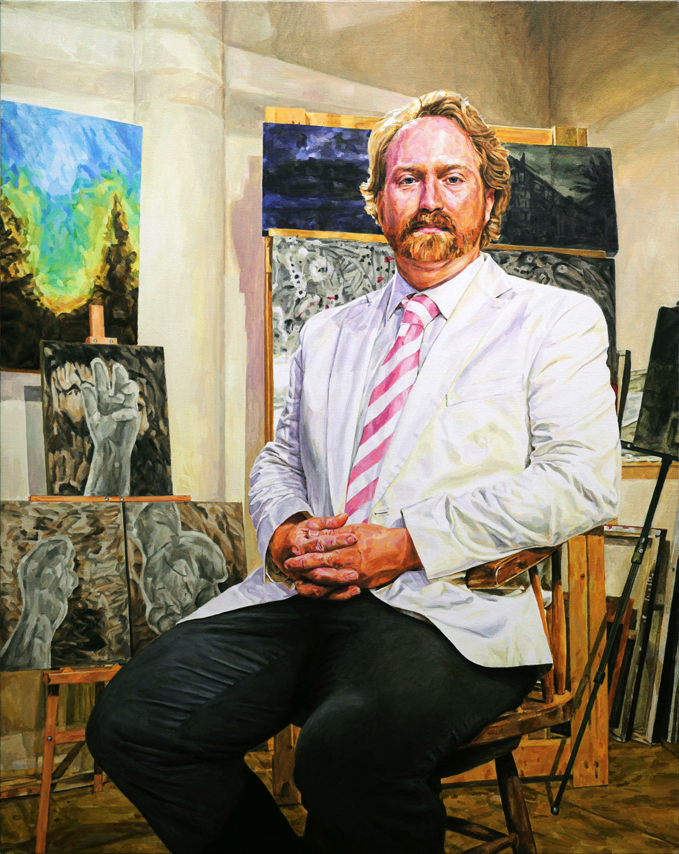
Alex, working (ACME Studios Series, Number 1)

'Alex' 50"x40" Acrylic on canvas
A "work in progress" of an artist friend of mine, chiefly a photographer although he also paints. This is still being worked on, as I'm not totally happy with the flesh tones and overall "feel". Acrylic is a wonderfully flexible medium to work with, but it does have issues, these principally for me being the relative strength of some of the dye-based paints.

However, it is superb for capturing sketches and preparatory work, the charcoal and acrylic study being an example of one of my "working" images.

The painting is somewhat busier than I would normally paint as a portrait, but I wanted to include some of his non-photograhic work in the background. As a successful photographer (and very shortly a first-time father), I imagine his output of paintings might trail-off... it captures a period of his life.


'Alex' 24"x18" Acrylic & charcoal on canvas

Thursday, December 15, 2011

Interviewed

'Kathleen' 30"x25" Charcoal on canvas
Being interviewed is strange... in many ways I find it slightly unsettling talking about myself rather than my art. It's not something I usually do.

A nice girl came to the studio and asked me questions, so rather than squirm, I drew her while she asked me the questions.

A short length of time to do the drawing, however it made me feel better to be doing something whilst talking.

Thursday, November 24, 2011

Training

I have a confession to make. For years when people asked me if I knew, or used, the "tonal method" I'd nod sagely... however, I didn't actually understand what they were on about.

Then about five years ago the penny finally dropped. This hallowed "tonal method" was nothing more than a part of the basic art training I had started to receive in secondary school (about age 13-14), and on into college. That was it, no big secret, no fancy "technique of the ancients".

I merely had the luck to be born, and to have my artistic training, just prior to the end of the traditional system of art education. We did life-drawing (even in secondary school), learnt how to make paint and other materials, anatomy, and so on. In other words, the old-fashioned stuff. No big deal or fuss was made over it, it was just considered a foundation upon which "real" artistic activity would be based by on-going actual practice thereafter.

All that said, the reason this came back to mind was a fellow artist a couple of days ago asking me in hushed reverent tones about "the academic tradition"... to which I unthinkingly replied "you mean basic training"?

That shocked them. The thought that such could be considered only a foundation, and not a "sacred end-in-itself", I don't think had occurred to them. To me it's just basic stuff that is first learnt, then adapted to actual "real" practice (possibly even being abandoned altogether).

What really knocked them was my saying that "training is only training, what use it is turned to in one's practice is what matters". Isn't that obvious?